What We Care About Shapes What We Remember
The brain doesn't store details like a computer. It prioritises what matters: personally, socially, culturally. This has real implications for how we teach, train, and lead.
A Biology of Learning
Think of the last thing you truly learned; not a fact you memorized for a test, but a skill or insight that stayed with you. Chances are, it was wrapped in a moment of high stakes, deep curiosity, or significant frustration.
What does this mean?
This isn't a coincidence. We have an entire brain network devoted to tagging what we feel matters.
Learning and emotion are not separate systems.
We don't have a "thinking brain" and a "feeling brain". We have a single biological engine that uses affect to decide what is worth the metabolic cost of building a new memory.
This biological reality can be used for practical strategies for education, leadership, and AI design. We can move beyond "engagement" and "relevance" as buzzwords and treat them as physiological requirements for cognition.
What about AI? A model is bound by the patterns it was trained on, where human thinking is forward-looking and theory-driven. It can predict but not theorise, represent an emotion, act as though it cares by pursuing a goal to completion. But that drive is the goal itself, not any felt sense of what reaching it means. It is at once more powerful and more limited than we assume, depending heavily on how it is used. Knowing how to use it ethically and effectively runs through all my work.
The Affective Architecture of Cognition
Attention Is Not Enough
We often think of learning as a matter of "paying attention." But attention is just the beginning.
The brain is a seesaw. It balances between two competing networks: the Executive Control Network (which focuses on tasks) and the Default Mode Network (which makes meaning).
If the seesaw is stuck in focus, we can perform but not grow, even burnout. If it's stuck in reflection, we can drift. The Salience Network is the pivot. It decides where the energy goes based on what we care about, benefitting our future.
True learning, where we don't just acquire knowledge but build a sense of who we're becoming, happens in the balance, tipping the seesaw back and forth.
Start Here
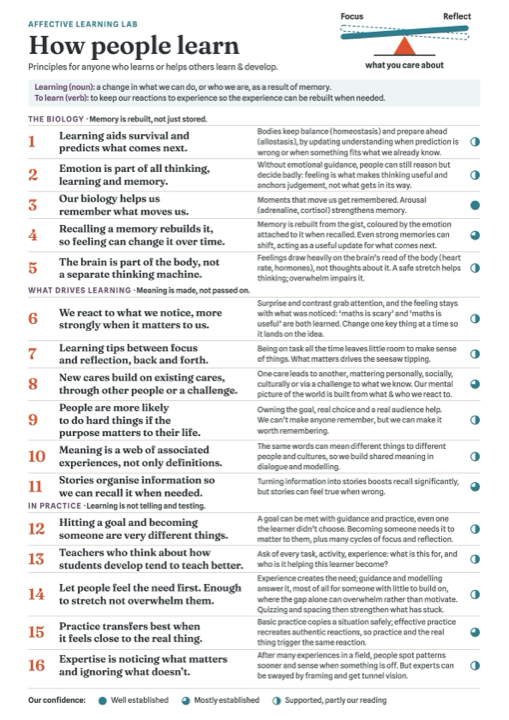
How People Learn
16 principles for anyone who learns or helps others learn, with the evidence behind each.
- The Biology: Memory is rebuilt, not just stored.
- What Drives Learning: Meaning is made, not passed on.
- In Practice: Learning is not telling and testing.
the science of^humanlearning
One Biology. Every Context.
The biology of learning doesn't change when you walk from a classroom into a boardroom. Affective foundations apply from a child's first lessons to a leader's hardest decisions. Here is where I help across that arc.
"What you have emotion about is what you're thinking about, and what you're thinking about you might be able to learn about."
— Mary Helen Immordino-Yang
The Black Box of Learning
What happens when the seesaw gets stuck? When we ignore the affective foundations, learning breaks down in predictable ways.
Salience Network
When we don't care, we don't learn well.
An overactive Salience Network leads to anxiety and hyper-vigilance.
Executive Control
When we are overwhelmed, we struggle to focus and learn.
A weak Executive Control Network leads to poor focus and impulsivity.
Default Mode
When we don't reflect, meaning and development suffers.
A suppressed Default Mode Network leads to shallow learning, reduced purpose and insights.
Deep Dive: The Affective Foundations
Download the foundational white paper for a technical breakdown of these network dynamics.
Building Learning Systems
That Work With Biology
Connecting affective neuroscience to classroom practice, workplace strategy, and leadership development.
Michael Goves
After 20 years in teaching and school leadership, I kept witnessing the gap between how we're told learning works and what actually happens, regardless of attainment and performance. It turns out the same problems persist in business. That gap led me to better understand human development.
With a Master's in Cognitive Science, as a graduate of the Oxford AI Programme, and 5Di accreditation, I bridge research and practice, informed by pioneering researchers such as USC's CANDLE lab in the US, to reveal how learning in schools and workplaces is driven by affect—the physiological requirement for cognition.
I serve as a national judge for the Teaching Awards, sit on steering groups centered on equitable and holistic education, and was awarded Top Overseas Teacher by Singapore's Ministry of Education.
I'm driven by a core belief: people deserve genuine, meaningful opportunities to develop and flourish. Adolescence is a particularly sensitive period where experiences literally build the brain networks that shape lifelong wellbeing and learning capacity.
My Mission
To establish affective neuroscience as the foundational science of learning and development. Learning and development has a purpose grounded in human development and flourishing, not ticking boxes.
Translating Biology to Practice
Four domains drive application of theory through research, workshops and resources.
Affective Education
From information transmission to developmental identity
Move beyond transmitting content to students by prioritising development as the purpose of education.
Design Features
- Environments of safety and non-violent communication
- Planning and teaching using the seesaw model
- Strategies for building salience and relevance
- Assessment approaches that honour agency and identity
Affective Workplace L&D
From Content Delivery to Performance
Move beyond completion metrics to performance change. Design workplace learning that respects the brain's homeostatic drive while enabling deep skill acquisition.
Design Features
- Performance-based design
- Social learning systems
- Just-in-time support
- Culture of psychological safety
Affective Leadership
Creating Conditions for Collective Learning
Leaders navigate complexity through affective foundations - understanding how emotions shape action, how change is personal, and how to make better decisions under uncertainty.
Design Features
- Using the seesaw model for strategic decision-making
- Emotional intelligence in systems change
- Managing resistance through affective understanding
- Using narrative to create organisational cohesion
Affective AI-Human Collaboration
Understanding the Human Advantage
AI lacks affect and cannot 'care.' Learn to leverage AI for information processing while preserving human judgement, meaning-making, and ethical decision-making across education, family, and workplace contexts.
Design Features
- Clear comparison between human and AI cognition
- Framework for task allocation (what AI should and shouldn't do)
- Safe and ethical AI integration strategies
- Developmentally appropriate AI use in education
- Practical tools for immediate implementation
Work With Me
Ready to support schools and businesses implementing affective approaches to learning and development.
Consultation & Advisory
I work with schools and organisations on:
- Affective-first pedagogy and classroom practice
- Leadership coaching using triple network frameworks
- AI implementation that honours human development
- Assessment and curriculum design
Get in touch to explore what we can do together. It depends on your culture and aims—or maybe you just want to discuss opportunities.
Speaking Engagements
Keynotes and workshops for conferences, schools, and organisations on:
- Affective neuroscience in practice and the seesaw model
- Why computational models fail adolescent development
- Triple network leadership and decision-making under uncertainty
- AI-human collaboration: What remains distinctively biological
For Educators
A toolkit of resources to understand the science behind affective learning and apply it in your classroom. Explore the frameworks, interact with the models, and dig into the research.
White Paper: Plain English version
A plain-English introduction to the academic framework behind Affective Learning Lab.
Memory Model: Affective Version
A marked-up visual explanation of how affective memory shapes learning.
Animated Seesaw and Schema Model
An interactive animation of the affective schema model and how the seesaw balances focus and reflection.
Research Partnerships
Help Bring Theory to Practice
I'm seeking education partners to co-develop and pilot affective learning frameworks and workshops. If your school or university is interested in exploring developmental thinking and collaborative implementation research, let's work together.
- Diagnostic assessment of current developmental practices
- Co-design of affective-first interventions
- Replicate Kundrak et al. Pedagogical Narratives research in your setting
Ideal partners: Schools committed to transformative education, willing to experiment thoughtfully.
Let's Work Together
Partner to build biologically grounded learning systems.
Direct
Speaking · Consulting · Research partnerships. Tell me a little about your context and I'll reply within 48 hours.